

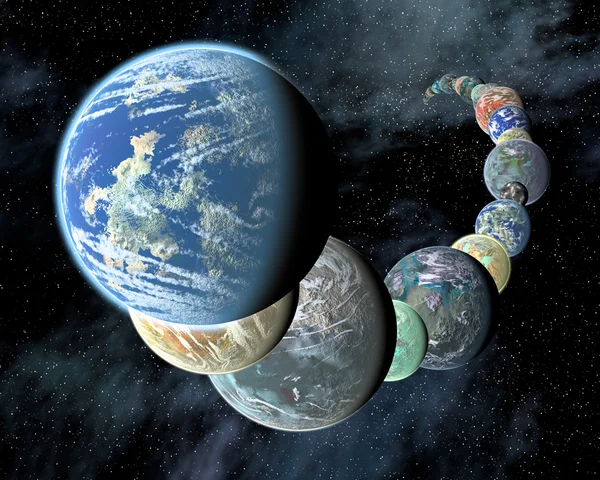
When we imagine habitable worlds, we tend to picture something like Earth: blue oceans, warm sunlight, breathable air, gentle weather, life blooming everywhere. But in astronomy, “habitable” doesn’t mean “Earth 2.0.” It doesn’t even mean beautiful or comfortable or familiar.
It has a very simple definition, based on what we know about life on Earth (which may not be totally comprehensive, but it’s the best we can do for now): A world is “habitable” if it could support liquid water.
That’s it! Not “does support water,” not “already has life,” not “would make a good vacation spot.” Just could.
But simplicity doesn’t make the idea any less magical.
“Habitable” planets open a doorway into possibility: the idea that somewhere out there, under a different star, another world might hold oceans, microbes, clouds, or something more.
So what actually makes a planet habitable? Let’s explore!
1. The “Goldilocks Zone”: Not Too Hot, Not Too Cold
The first requirement is location. Specifically, how far a planet sits from its star.
If it’s too close, the world becomes a scorched desert. If it’s too far, everything freezes. But right in the middle is the habitable zone, where temperatures could allow liquid water to exist.
However… the Goldilocks zone isn’t a guarantee. Venus sits in the habitable zone but is hot enough to melt metal. Mars sits near the edge but lost most of its atmosphere.
So distance matters, but it isn’t everything.
2. An Atmosphere That Acts Like a Protective Blanket
Even if a planet is in the perfect orbit, it needs an atmosphere to: hold onto heat, protect from radiation, keep water from instantly boiling or freezing, support stable weather.
Without an atmosphere, you get a world that’s basically a cosmic popsicle or a radiation-baked rock.
But with the right atmosphere? You can get balance. Warmth. Clouds. Maybe even oceans.
The atmosphere is where possibility begins.
3. The Right Size: Not Too Small, Not Too Big
A planet’s mass matters because:
too small → it can’t hold onto its atmosphere
too big → it becomes a mini-Neptune with crushing pressure
Earth is just the right size to hang onto breathable air and support liquid water.
Super-Earths might be even better: some could have stable climates, thick atmospheres, and long-lasting oceans.
Size shapes everything.
4. A Stable Star (Preferably Not a Drama Queen)
If a star is too active (flaring, blasting radiation, changing brightness) it can destroy a planet’s chance at habitability.
Some stars are calm and steady, like our Sun. Others, like red dwarfs, can be: temperamental, flare-prone, unpredictable. Yet even those might host habitable planets hidden behind thick atmospheres or oceans.
A planet needs a star that gives more life than it threatens.
5. Time: The Universe’s Most Important Ingredient
Life takes time. Not just millions of years, but billions.
A planet could have the perfect:
orbit
atmosphere
temperature
star
…but if it exists or existed for only a short cosmic moment?
Life might never have the chance to begin.
Habitability is not just a snapshot. It’s a timeline.
6. Habitability Doesn’t Look Only One Way
This is my favorite part:
A habitable world might not look anything like Earth.
It could be:
an ocean planet with no land
a dim world lit by a red star
a Super-Earth hidden under thick clouds
a Hycean world with warm water and hydrogen skies
a rocky world orbiting a white dwarf (my favorite category!)
Habitability is not a single recipe: it’s a spectrum. A possibility space. A reminder that life might thrive in forms we can’t yet imagine.
A Final Thought: Habitability Is About Hope
To me, the idea of a “habitable world” is one of the most hopeful concepts in astronomy. Not because we expect to find alien civilizations tomorrow, but because the universe naturally creates environments where life could bloom.
It means Earth isn’t a cosmic accident. It means life might not be rare. It means the universe is generous with its possibilities.
Every potentially habitable world is like a quiet promise: there might be others.
And that’s why I love exploring them — because each one expands the story of what’s possible in the universe.
