

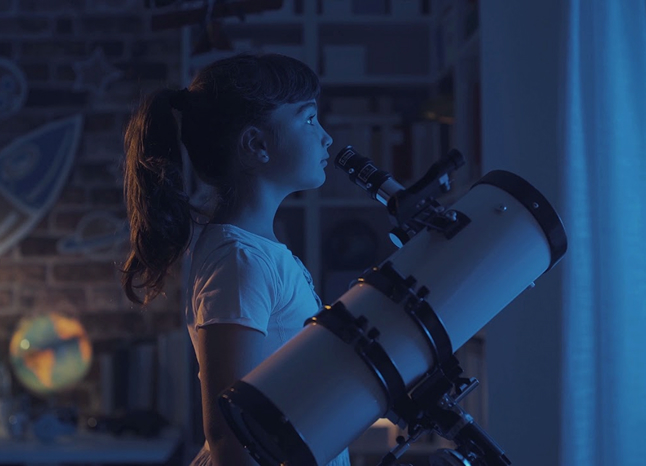
When I first fell in love with astronomy, I didn’t think much about who “belonged” in space science. I just knew that the sky made me feel something (wonder, peace, curiosity, excitement, etc) and I wanted to understand it.
But the more I learned, the more I realized something important: the field of astronomy hasn’t always made room for everyone who loves it.
For generations, girls who dreamed of space were told, quietly or loudly, that they didn’t fit the picture of what a scientist looks like.
But here’s the truth: Girls have always belonged in space science. Girls have always been curious enough, brilliant enough, imaginative enough. And girls have always been part of the universe, so why shouldn’t they help explore it?
Girls Have Been Here All Along
Long before it was normal to see women in STEM, girls were already shaping astronomy:
Henrietta Leavitt, who discovered how to measure the universe with Cepheid variables
Vera Rubin, who proved dark matter exists
Annie Jump Cannon, who classified hundreds of thousands of stars
Jocelyn Bell Burnell, who discovered pulsars as a graduate student
Katherine Johnson, who helped send astronauts to the Moon
They were pioneers.
But many of their achievements were overlooked or credited to others. Girls in astronomy weren’t celebrated the way they should have been.
Today, the story is changing.
Why Girls Belong in Space Science Now More Than Ever
Space science needs imagination, perspective, compassion, creativity, curiosity, patience, collaboration.
And girls bring all of that, often in ways that are unique and essential.
Girls look at the stars and see possibility. Girls approach science with both heart and intelligence. Girls ask questions no one else thinks to ask. Girls bring empathy and openness into a field that thrives on wonder.
The sky isn’t limited. The universe isn’t limited. And girls shouldn’t be either.
Wonder Is a Superpower
Sometimes people think being good at science is all about formulas and calculations. But at its core, astronomy is about wonder, and girls naturally excel at wonder.
Girls imagine exoplanets as stories. Girls look at galaxies and feel awe. Girls connect the sky to feelings, meaning, and creativity. Girls understand that space science is not just about answers, but about questions, and girls ask some of the best ones.
Wonder is not a soft skill. It is the beginning of every discovery.
Breaking Stereotypes
Being a girl in space science means learning to ignore a lot of “Are you sure this is for you?” energy. It means believing in your curiosity even when others don’t. It means letting your passion speak louder than people’s assumptions.
But it also means community: other girls, women, mentors, and students who are all rising together.
Every girl who loves space becomes part of a constellation of voices proving that science is for everyone.
Every Girl Who Looks Up Belongs Here
If you’re a girl who stares at the Moon a little too long, who memorizes constellations, who imagines walking on another planet, who wonders how stars are born —
Congratulations! You are already a space scientist in the making.
The field needs your imagination. It needs your perspective. It needs your courage. It needs your joy. And it needs your voice: loud, curious, unafraid.
Girls in space science are not the exception.
They are the future. They are reshaping what the universe looks like through their eyes, their research, their questions, and their dreams.
The sky belongs to all of us. And girls who dare to look up, wonder, and explore are helping the world remember that.
The universe is wide. The stars are waiting. And girls, all girls, deserve a place among them.
