

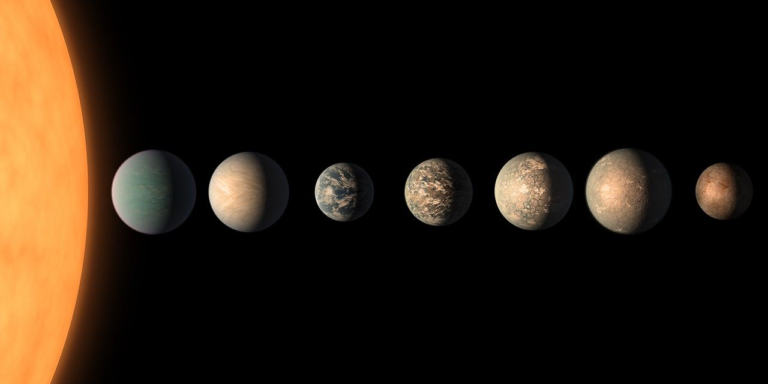
One of the wildest things about astronomy is that almost all the exoplanets we’ve discovered, thousands of them, are worlds we have never actually seen directly.
They don’t show up as little dots in telescope images. They don’t glow like stars. They don’t shout, “Hey! I’m here!”
Instead, we detect them through tiny clues: a flicker of starlight, a wobble, a shadow, a whisper hidden in data.
Finding an exoplanet is like solving a cosmic puzzle where the planet never appears, only its effects do.
Here are the main ways astronomers detect distant worlds, and how we discovered some of the most famous planetary systems like TRAPPIST-1 (my favorite so far!)
1. The Transit Method: When a Planet Makes Its Star Blink
This is the most successful and common way we find exoplanets.
A “transit” happens when a planet passes in front of its star (from our point of view), causing the star’s brightness to dip ever so slightly.
It’s like watching a firefly dim for a millisecond because something tiny crossed in front of it.
What astronomers look for:
A repeating pattern of dips
Consistent timing
Consistent depth
A shape that tells us about the planet’s size
A deeper dip = a bigger planet. A shallow dip = a smaller planet. Many other planetary and stellar properties can also be inferred based on the size and depth of the dips!
TRAPPIST-1 was discovered this way.
The TRAPPIST telescope noticed repeated dips in the same star’s brightness. One planet. Then another. Then another. Eventually, seven Earth-sized worlds, three in the habitable zone!!
TRAPPIST-1 is a perfect example of how a tiny flicker of starlight can reveal an entire system of worlds.
2. The Radial Velocity Method: The Star’s Little Wobble
Planets don’t just orbit stars; stars also wobble slightly because planets tug on them.
Even giant Jupiter makes our Sun wobble.
Astronomers measure that wobble as tiny shifts in the star’s light:
If the star moves toward us → its light shifts slightly blue
If it moves away from us → its light shifts slightly red
This is called the Doppler Effect, the same thing that makes a siren change pitch as it passes by.
What wobble reveals:
The planet’s mass
The shape of its orbit
Whether the system has multiple planets
The very first exoplanet ever discovered around a Sun-like star (51 Pegasi b) was found through radial velocity.
3. Direct Imaging: Actually Taking a Picture of the Planet
This method is rare but stunning.
Planets are very dim compared to their stars. Imagine trying to see a tiny candle next to a stadium floodlight: that’s what astronomers deal with.
To directly image a planet, we need:
Extremely large telescopes
Very distant or young, hot planets
A way to block the star’s light (a coronagraph)
This gives us breathtaking images of exoplanets like those in the HR 8799 system, actual glowing planets captured directly.
But direct imaging works mostly for:
Big planets
Far from their stars
Very young and hot
So this method gives us beauty, but not huge numbers.
4. Gravitational Microlensing: Planets Revealed by Gravity’s Glow
This method uses Einstein’s general relativity in the coolest way: When a star passes in front of another star, its gravity acts like a magnifying glass and brightens the background star.
If the foreground star has a planet, that planet causes a second little blip in the brightness.
This can detect:
planets far from their stars
small planets
rogue planets drifting alone
Microlensing shows us planets we can’t find any other way.
5. Timing Variations: When Planets Tug on Each Other
This method is especially useful in multi-planet systems.
If one planet transits a star slightly early or late, something else is tugging on it, maybe another planet.
This is how we confirm tightly packed systems like TRAPPIST-1. The planets tug on each other in a delicate gravitational dance, making their transit timings drift by minutes.
Those slight timing shifts help determine:
planet masses
orbital resonances
system dynamics
It’s like watching the rhythm of a cosmic mobile.
Why It Matters That We Detect Planets We Can’t See
To me, this is one of the most beautiful parts of astronomy: we’re discovering entire worlds through shadows, wobbles, glimmers, and tiny acts of light.
We’re finding oceans we can’t touch, atmospheres we can’t breathe, skies we can’t stand under and worlds we may never visit
all through hints and patterns.
It feels like learning to listen to the universe instead of waiting for it to speak loudly.
And systems like TRAPPIST-1 remind us that even the smallest signals can lead to the biggest discoveries.
A Final Thought
Detecting exoplanets isn’t just science; it’s a kind of cosmic intuition. A way of reading starlight like a story. A practice of noticing the smallest details and realizing they point to something enormous.
We’re surrounded by worlds we’ve never seen, orbiting stars we’ll never visit filled with stories we’re only just beginning to uncover.
And all it takes is a flicker, a wobble, a whisper of light — and suddenly, a new world is born, and eventually, found!
